Science birthday party ideas are everywhere online — the hard part is knowing which ones survive contact with a room full of excited kids. We host science birthday parties every weekend at our labs in Texas and Utah, so we’ve watched hundreds of these succeed (and a few flop). The short answer: six of the best ideas you can run at home with grocery-store supplies, and six are genuinely better in a real lab. Below is exactly which is which, with the honest reasons why.
Key Takeaways
- Six strong at-home ideas: volcanoes, slime, balloon rockets, bubble tests, sun prints, and fizzy sidewalk paint — each one kid-run, not watched.
- Six lab-level experiences — dry ice, real labware, glow chemistry, rocket launches, forensics, and custom themes — are safer, bigger, and zero-cleanup in a real lab.
- The best science party idea at any age is the one where every child does the experiment, because doing beats watching for engagement and motivation.
- Ages roughly 4–10 are the science-party sweet spot, but a good lab scales the same experiments from preschoolers to teens.
- At Little Beakers, a scientist leads the lab session and you take care of the celebrating in your private party room — just bring your food, cake, decorations, and the kids!
What Science Birthday Party Ideas Cover
A science birthday party is any party where the activities are hands-on experiments the kids perform themselves — chemistry reactions, physics builds, gooey polymers — rather than science demonstrations or entertainment they simply watch. That covers two very different plans: the DIY route at your kitchen table, and a hosted party at a kids’ science lab. This guide covers both honestly, because we run a lab and we’ll still tell you: some of these ideas work great at home.
One principle carries the whole list. Research on young kids consistently finds that hands-on science activity — actually touching, mixing, testing — is what builds motivation for science. The source: a 2024 quasi-experimental study of preschoolers published through ERIC. At a party, that translates to a simple rule: every kid gets their own volcano. Nobody watches from the back row.
Six At-Home Science Party Ideas
You don’t need a lab to get started. These work with a plastic tablecloth and supplies from the grocery store.
1. Erupting volcanoes
The classic for a reason. Baking soda, vinegar, dish soap, and food coloring. Let each kid build and erupt their own instead of watching one big version. The doing is the fun part, and the fizz is an acid-base reaction they can repeat until the vinegar runs out.
2. Make-your-own slime station
Kids love making polymers, even if they just call it slime. Glue, contact-lens solution, baking soda; each guest mixes a custom color to take home. It doubles as the party favor, which quietly solves your goody-bag problem.
3. Balloon rockets
Tape a straw to a balloon, thread it on a string across the room, and race. A genuinely good first lesson in thrust — and it burns energy before cake.
4. Bubble science
Bigger wands, different soap mixes, square frames. Have kids test which mix makes the strongest bubble. That’s a real experiment: change one thing, watch what happens.
5. Sun prints
For daytime parties, sun-print paper turns leaves, toys, and hands into keepsake art. Kids learn that sunlight carries invisible ultraviolet radiation — the same UV the EPA’s UV Index measures. Quiet, calm, and a natural wind-down station.
6. Fizzy sidewalk paint
Baking soda, cornstarch, water, food coloring. Kids paint the driveway, then spray it with vinegar and watch their art fizz. The next rain handles cleanup.
A word of honesty from someone who hosts parties for a living: at-home science parties are great, and messy, and you’re the one running every station while also serving cake. Plan one adult per activity, and put down more plastic than you think you need.
Six Lab-Party Experiences Worth Leaving the House For
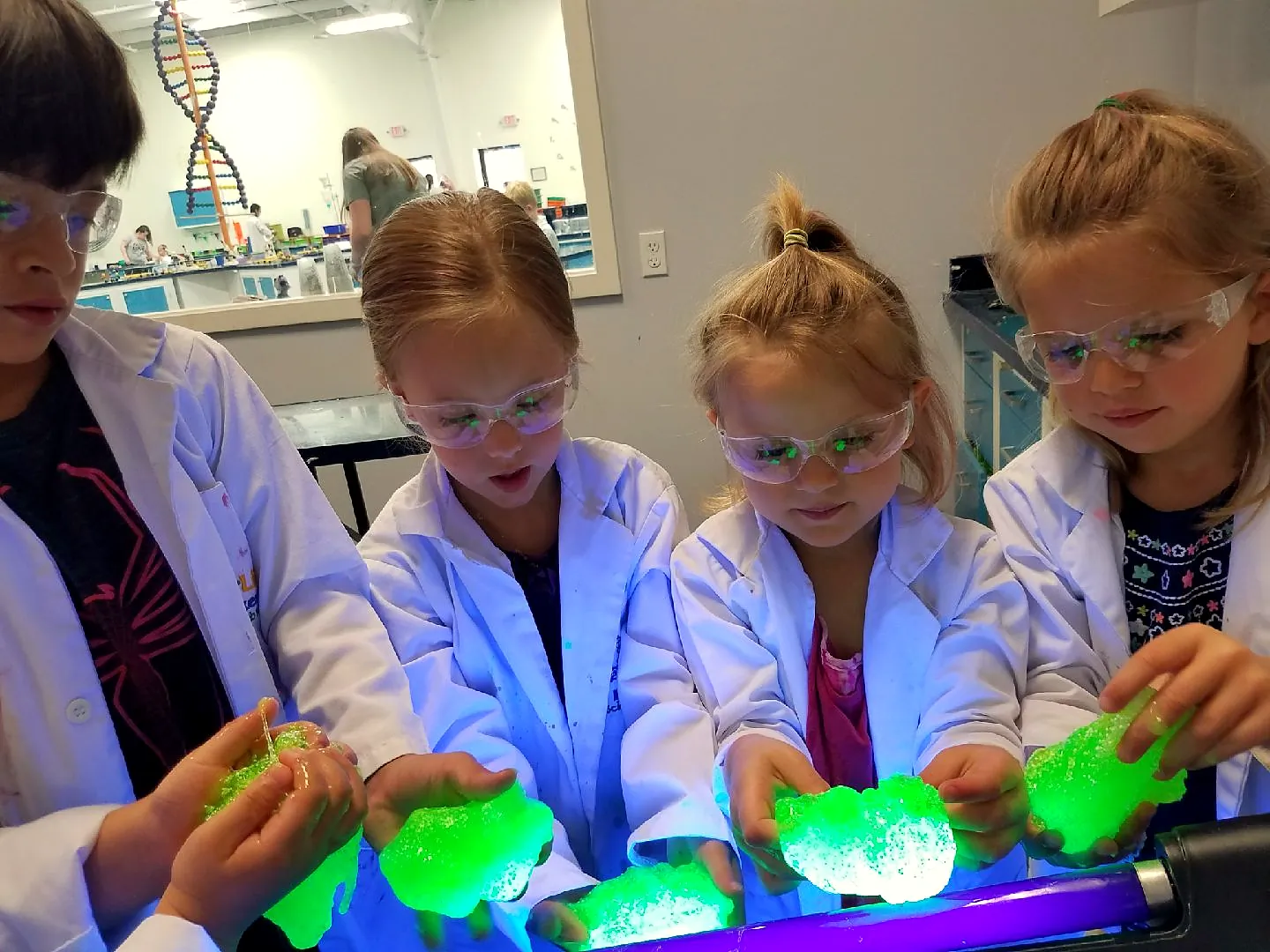
Some experiments are hard to do safely — or affordably — at home. That’s the entire case for a science birthday party at a real lab: kids in safety glasses, real equipment, one of our scientists leading, and the setup and cleanup on us.
7. Dry ice, done safely
Foggy, bubbling, unforgettable — and genuinely not a DIY material. Dry ice is cold enough to injure bare skin and needs ventilation, which is why the dry ice safety data sheet calls for gloves and airflow. In the lab, kids get the full foggy experience with the handling done right — and real answers about sublimation.
8. Chemical reactions with real labware
There’s something about real labware — volumetric flasks, Erlenmeyer flasks, lab powder funnels, and pipettes — that a plastic cup can’t match. Kids measure, mix, and react like actual chemists — because for that hour, they are.
9. Glow experiments
Glowing solutions under black light turn chemistry into something kids talk about for weeks. A crowd favorite at our Parents’ Night Out events, and a natural party centerpiece.
10. Rocket launches
Design, build, launch. Kids use acid-base reactions as rocket fuel and feel Newton’s laws in their hands — without anyone’s backyard fence paying the price.
11. Forensic mystery parties
A whodunit where the guests are the detectives: fingerprints, hair samples, mystery powders. Perfect for older kids who’ve outgrown the volcano stage.
12. A theme built around your kid’s obsession
Robots, magnetic slime, magnets, a dinosaur fossil dig, sharks, frogs — the strongest science party themes start with whatever your child already loves and build real experiments around it. Tell us the obsession; we’ll match the science.
Matching Party Ideas to the Age Group
The most common planning mistake is picking experiments for the age on the invitation instead of the range in the room.
- Ages 2–3: big, visual, forgiving — volcanoes, bubbles, sidewalk paint. Short experiment duration, fast payoffs.
- Ages 4–10: the science-party sweet spot. Old enough for real labware and multi-step experiments, young enough that everything is still magic.
- Ages 11–16: give them forensics, glow chemistry, rocket engineering — science with an edge of competition or mystery.
- Mixed ages (most family parties): this is where a lab earns its keep. Our experiments scale — the same set of experiments runs simpler for a 4-year-old and deeper for a 14-year-old, so every kid participates. That’s the whole point of Little Beakers.
The Science Party Planning Timeline
Whichever column you picked, the countdown looks like this:
Three to four weeks out. Lock the date and the theme. If you’re booking a lab, this is when to call — weekend slots are the first to go, and knowing your headcount early lets the lab set up properly. If you’re hosting at home, this is when you order the specialty items (sun-print paper, glow sticks) so shipping can’t sabotage you.
One week out. Home hosts: run every experiment once, yourself, without kids. Not optional. The volcano recipe that “everyone knows” has ruined more parties than rain — old baking soda barely fizzes, and you want to discover that on Tuesday, not mid-party. Confirm your one-adult-per-station roster. Lab bookers: confirm your final headcount and mention any allergies.
Day before. Home: pre-measure everything into labeled cups — party-day chemistry should be assembly, not measuring. Lay the plastic. Lab: relax, genuinely. Your job tomorrow is cake transport.
Party day. Home: run stations 15–20 minutes each and end with the messiest one. Lab: arrive with the kids and the cake; safety glasses, labware, materials, scientist, and cleanup are on us.
The weather clause. Home hosts running outdoor stations (sidewalk paint, sun prints, rockets) need an indoor swap ready — slime and volcanoes move inside gracefully; sun prints don’t. Lab parties are weather-proof by definition, which quietly matters in a Houston summer and a Utah January alike.
The favor move (both columns): whatever the kids made — slime, sun prints, a bot — IS the goody bag. It’s cheaper than trinkets and it’s the thing they’ll actually keep.
The Science Hiding in the Fun (Talking Points for Parents)
Kids don’t need a lecture at a party — but when one asks “why did that happen?”, having a one-line real answer is gold. Keep these in your pocket:
- Volcanoes: vinegar (an acid) plus baking soda (a base) makes carbon dioxide gas — the fizz is the gas escaping.
- Slime: glue is long chains of molecules; the activator links the chains together. That’s what “polymer” means, and your child just engineered one.
- Balloon rockets: air rushing out one way pushes the balloon the other way. That’s Newton’s third law, at birthday-party scale.
- Bubbles: soap molecules sandwich a layer of water; the strongest mix balances stretch against evaporation. Changing the recipe and re-testing is exactly what materials scientists do.
- Sun prints: the paper’s coating reacts to invisible ultraviolet light — anything blocking the UV leaves its shadow behind.
At a Little Beakers party, our scientist handles the “why” in kid language at every station. Parents tell us that’s the part that separates a science party from a party with science-themed decorations.
Science Birthday Parties Around Houston and Salt Lake City
If you’re near one of our labs, the lab-party column above isn’t hypothetical. We host science birthday parties at all five Little Beakers locations: Cypress, The Woodlands, and Katy/Memorial in the Houston area, and Sandy and Orem along Utah’s Wasatch Front. Every party is the same format: a hands-on lab session led by a Little Beakers scientist, then a private party room for cake and celebrating.
Why the Right Party Idea Matters More Than the Decorations
Here’s the outcome nobody puts on the invitation: a party where your kid did science — instead of watching it — changes how they talk about science afterward. The research on hands-on learning cited above points the same direction we see every weekend. Kids who run the experiment themselves come back asking what happens if…? A bounce house burns an afternoon. A lab bench sometimes lights a fuse. Our founder — a military and aerospace polymers chemist who got her start with science sets at her mom’s kitchen table — wrote the longer case in our guide to hands-on science for kids.
And practically, the lab version costs you zero setup, zero cleanup, and zero moments of suddenly running six stations alone.
What to Do Next
- Pick your column. Under 8 guests and a patient adult per station? The at-home six will serve you well. Bigger group, mixed ages, or a kid who deserves the real thing? Book the lab.
- Start from the obsession. Choose the theme from what your child already loves.
- If you’re booking: check your nearest location’s science birthday party page for what’s included, then call 1-833-KIDS-LAB (1-833-543-7522) with your date and headcount.
- If you’re hosting at home: assign one adult per station, lay plastic, and steal our take-home-slime-as-party-favor trick.
Keep Reading: The Little Beakers Guide Series
- Hands-On Science for Kids: The Complete Guide — the master guide this post belongs to.
- Open Lab Explained — the reserve-an-hour way to keep the science going after the party.
- Parents’ Night Out at the Science Lab — the drop-off evening version.
- Science Camp Checklist — when a party turns into wanting to do it all week.
Science Birthday Party FAQs
What age is a science birthday party good for? Younger than most parents think. We host parties from preschool through the teen years; the sweet spot is around 4–10, and experiments are matched to each age group.
How many kids can I invite to a science party? Most families plan for roughly a dozen guests, and our party rooms are built for exactly that. Give us your headcount when you book and we’ll set the lab up for your group.
Is a science birthday party safe for little kids? Yes — that’s one of the biggest reasons families choose a lab over DIY. Everything is age-appropriate and kid-safe, run by our scientists, with kid-sized lab coats and safety glasses.
How long does a science birthday party last? Plan on about two hours at Little Beakers: a jam-packed hands-on lab session, then private party-room time for cake and presents.
Do parents stay for the party? Parents are welcome — and most end up as interested in the experiments as the kids.
About Little Beakers
Little Beakers is a hands-on science lab for kids ages 2–16, founded by military and aerospace polymers chemist Dr. Cinttya Morgan so that any child — from any background — could walk into a real lab, use real equipment, and get inspired. Five locations: Cypress, The Woodlands, and Katy/Memorial in Texas; Sandy and Orem in Utah.
Ready to book the easiest great party you’ll ever throw? Visit our science birthday party page or call 1-833-KIDS-LAB (1-833-543-7522).
About the author: Trevor Morgan is the owner of Little Beakers and runs day-to-day operations across all five locations. He has hosted more kids’ birthday parties than he can count and still thinks the glow experiments are the best part.