By Dr. Cinttya Morgan, Founder & Lead Scientist · Last updated September 2026.
Hands-on science is how children actually fall in love with science — not by watching it, but by doing it. I can tell you that as a military and aerospace polymers chemist, because the research says so. I can tell you it as a founder, because I’ve watched thousands of kids prove it at our lab benches. And I can tell you it as a kid who lived it: I learned science from sets my mom found for me when camps weren’t in our budget. This guide is everything we know about getting a child from “science is a school subject” to what happens if…? It covers the whole range — at home, at a lab, in an hour or over a whole summer.
Key Takeaways
- Doing beats watching, measurably: in the largest analysis of its kind, students in lecture-style classes were about 1.5 times more likely to fail than students who learned actively.
- Motivation is buildable: hands-on activities measurably increased science motivation even in preschoolers — you don’t have to wait until a child is “old enough.”
- Real equipment matters. A pipette in a child’s hand teaches precision and pride that a plastic spoon can’t.
- Science is for every kid — not only the ones already excelling at school. The hands-on format meets every kind of learner.
- There’s a right entry point for every family: one reserved Open Lab hour, a birthday party, a weekly class, a camp week, or a school field trip. This guide maps them all.
- You can start today, at home, with what’s in your kitchen.
What Hands-On Science for Kids Covers
“Hands-on science” means the child performs the experiment: they measure, mix, predict, test, observe, and record. It’s the opposite of science-as-audience — videos, assemblies, demonstrations where something fizzes on a stage while kids clap. Both can spark a moment of wonder. Only one builds a scientist, because only one puts the question in the child’s hands.
This guide covers the whole territory: the evidence that doing beats watching, what you can run at your own kitchen table, and where home hits its limits. It also covers each of the six ways families use a real kids’ lab: Open Lab, birthday parties, and camps. Rounding out the list are homeschool and after-school classes, field trips and group events, and Parents’ Night Out evenings.
The Evidence: Why Doing Beats Watching
Start with the numbers, because they’re striking.
The largest meta-analysis ever conducted on this question looked at 225 studies, published in the Proceedings of the National Academy of Sciences. The finding: active learning raised exam performance by about 6%, while students in traditional lecture classes were roughly 1.5 times more likely to fail than students who learned by doing. Those are college numbers, but the mechanism they reveal — doing, not watching — doesn’t wait for college.
It starts astonishingly early. A 2024 controlled study of preschoolers found that hands-on science activities measurably increased science motivation in children as young as five — girls and boys alike. Motivation, at five, from touching the science instead of watching it.
And it doesn’t have to happen in a classroom at all. The National Academies’ landmark report Learning Science in Informal Environments concluded that real science learning happens across a lifetime of informal settings — science centers, family activities, everyday experiences. Translation for a busy parent: the hour you spend at a lab bench with your kid on a random Saturday counts. It all counts.
What I add from my own years at the bench: the moment a child runs their own reaction, their question changes. “What is that?” becomes “what happens if…?” That question is science. Everything else is scenery.
Science Is for Every Kid — Not Just the “Gifted” Ones
Here’s the wall I’ve spent my career trying to knock down. It’s the idea that science belongs only to the kids already excelling at school, or to the ones somebody calls “gifted” kids.
It isn’t true, and I’ve watched thousands of kids across every age and background prove it isn’t. The kid who won’t sit still for a worksheet will stand at a lab bench for an hour. The quiet one who never raises her hand will tell you exactly why her bubble mix beat everyone else’s. Different learners, same doorway — as long as the doorway is a bench and not a lecture.
That belief is why Little Beakers exists. I grew up without expensive camps; my mom found science sets, and I worked through them at our table. It became fun — but more than fun, it stuck. When I became a mom myself, I went looking for a place where any family could simply reserve a slot and walk in, even for one hour. Their child could use real equipment there and get inspired. There wasn’t one. So we built it — and built Open Lab specifically to remove the cost-and-commitment barrier that kept families like mine out.
Start at Home: Kitchen-Table Science That Actually Teaches
You do not need a lab to begin. You need a habit — the predict-test-observe-record loop — and a kitchen:
- Kitchen chemistry. Baking soda and vinegar, then go further: change amounts, change temperature, have your child predict before each run and write what actually happened. Congratulations — that notebook is a lab notebook.
- Polymer play. Slime is legitimate chemistry: cross-linking polymers your child can feel changing in their hands.
- Physics you can race. Balloon rockets, ramps, paper airplanes with one variable changed per flight.
- Backyard biology. Collect, observe, sketch, classify. A magnifying glass and a notebook go a long way.
If a birthday is on the calendar, we’ve turned this philosophy into a party plan. See Science Birthday Party Ideas: 12 Experiments Kids Actually Love — six for home, six for the lab.
The pattern in all of it: the child predicts, tests, observes, records. Keep that loop running and you’re teaching more real science than many classrooms manage.
Where Home Hits Its Limits
Three walls, and hitting them doesn’t mean you’ve failed:
1. Equipment. Titrations, real plasticware, technique. A pipette teaches a precision a plastic spoon can’t — and lab equipment is expensive for one child but sensible when a whole community shares one lab.
2. Dissections. Specimens, tools, disposal, and a guide who knows the anatomy. Nobody wants a frog dissection next to the fruit bowl. Yet dissection is where biology stops being pictures and becomes structure your child has actually seen.
3. Other kids at the bench. Comparing results, defending a prediction, watching someone else’s experiment behave differently — that back-and-forth is the scientific method, socially embodied.
Which brings us to the lab — and the six different doors into ours.
Six Ways Into a Real Lab (Pick Your Entry Point)
The one-hour test drive: Open Lab
The lowest-commitment first step in kids’ science: reserve a slot, safety glasses on, and your family works through 30+ self-guided experiments together at your own pace. No enrollment, no semester — this is the offering we built first, and it’s still the best answer to the question every parent asks: will my kid even like this? Full explainer: Open Lab Explained: A Parent’s Guide · booking: Open Lab & memberships.
The celebration: a science birthday party
A hands-on lab session led by one of our scientists, then a private party room for cake — about two hours, zero setup or cleanup for you. Ideas and honest home-vs-lab advice: Science Birthday Party Ideas · booking: science birthday parties.
The deep dive: science camps
Themed, multi-day school-break programs — summer, spring break, and holidays — where kids run real experiments every single day, about seven activities per camp day, across 19 themes. How to pick well: the Science Camp Checklist · booking: science camps.
The weekly habit: classes
Homeschool, after-school, and preschool programs, including workshops, guided and dissection sessions (frog, shark, squid, sea star — scientist-led, age-appropriate). If you homeschool, this is the missing lab component, not a replacement for your curriculum: Hands-On Homeschool Science · booking: science classes.
The class trip: field trips & group events
Schools, homeschool co-ops, scout troops, and daycares — up to 200 students at our largest locations, every student doing the science, with packages split by grade band. Planning guide: Science Field Trip Ideas Students Actually Remember · booking: group events & field trips (or request an on-site event and we come to you).
The night off: Parents’ Night Out & workshops
A themed three-hour drop-off evening — kids run six-plus experiments, parents get a date night. Plus one-day and multi-day workshops and special events. What to expect: Parents’ Night Out at the Science Lab.
Which entry point fits your family? (Best for / skip if)
| Entry point | Best for | Skip if |
|---|---|---|
| Open Lab | First-timers, unsure kids, tight budgets, rainy Saturdays | You want instruction — Open Lab is self-guided by design |
| Birthday party | Mixed-age guest lists, parents done with bounce houses | The guest of honor hates being the center of attention at stations — talk to us, we can shape it |
| Camp | A kid with an obsession + a school break to fill | Your child has never tried the lab — do an Open Lab hour first |
| Classes | Homeschoolers needing the lab component; after-school routine builders | Your schedule can’t hold a recurring slot yet — start with workshops |
| Field trip | Teachers, co-ops, troops, daycares | Groups under ~10 — come to Open Lab together instead |
| PNO / workshops | Parents needing an evening; kids who want a taste of camp | Kids who aren’t ready for drop-off — bring them to Open Lab where you stay |
One honest meta-rule sits under this whole table: start smaller than you think. The family that books an Open Lab hour and upgrades to camp always ends up happier than the family that booked a full week on faith. Science rewards iteration; so does buying it.
What “Real Equipment” Actually Means (and Why Kids Can Tell)
I keep saying “real equipment,” so let me be specific, because the specificity is the point.
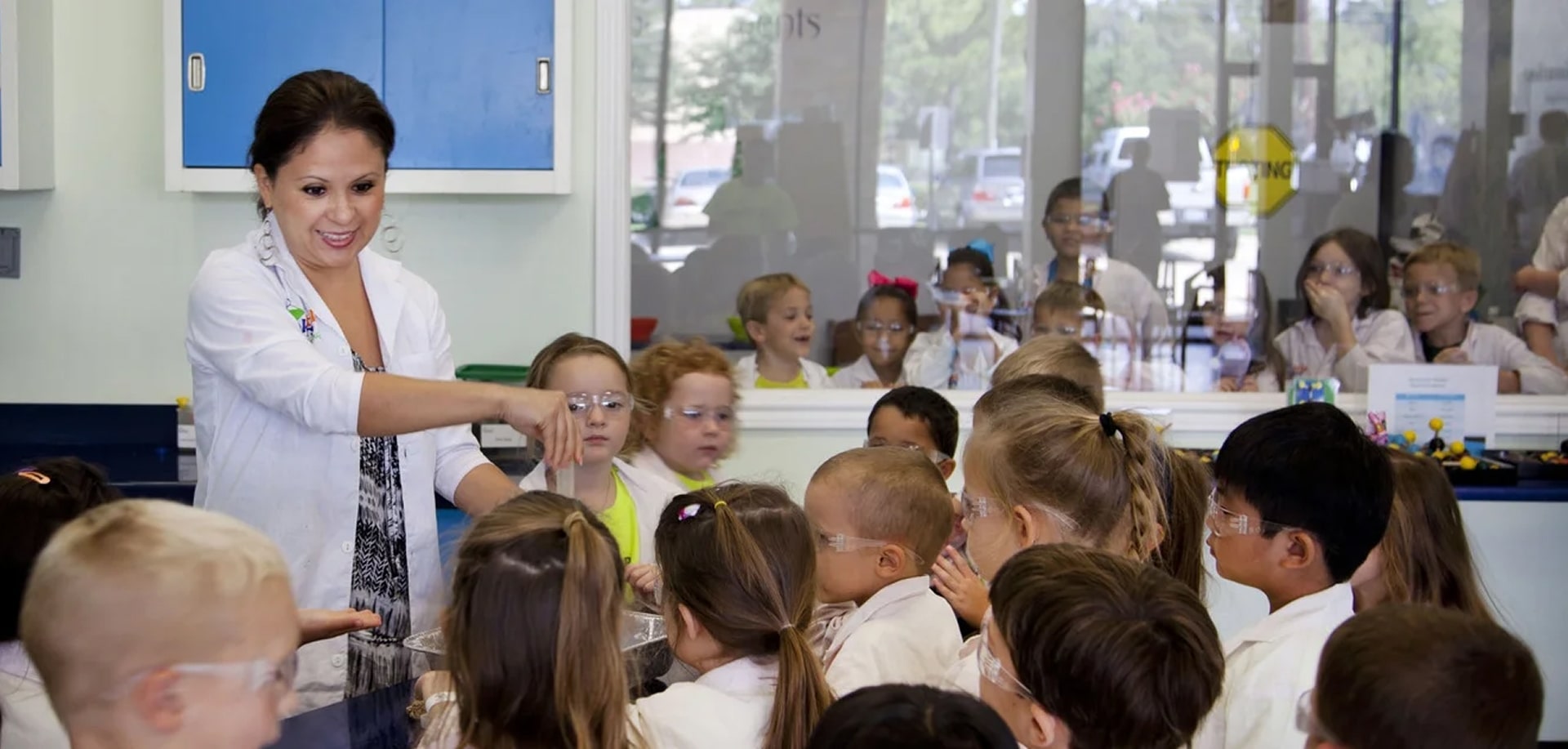
At our benches, kids use volumetric flasks, separatory funnels, pipettes, burettes, test tubes in racks, safety glasses, and reagents measured in real units. In dissection sessions they use actual dissection tools on actual preserved specimens — frogs, sharks, squid, sea stars. When they build rockets, the fuel is a real acid-base reaction they mixed themselves.
Why does this matter more than it seems? Three reasons:
- Precision is a teachable feeling. A pipette forces a steadiness and attention that a plastic spoon never asks for. Kids rise to the tool.
- Trust reads as respect. We use durable plasticware at the bench, not toy-store plastic — the same volumetric flasks and pipettes a real lab uses, just built to survive a seven-year-old’s grip. Handing a kid that equipment says we believe you can do this louder than any pep talk. Kids hear it. They handle it more carefully than most adults expect — nearly universally.
- Pretend has a ceiling. Kids know the difference between a lab and a craft table dressed up as one. The pride of “I used the same tool real chemists use” is half of what they carry home — and it’s the half that turns into identity.
Every instructor guiding that equipment is background-checked, and every experiment is age-scaled. Real doesn’t mean risky; it means honest.
The Four Questions Every Parent Asks Us (Answered Honestly)
About 55,000 kids have come through Open Lab, and the same four questions come up at every location, every week — so let’s answer them the way I would at the front desk.
“Is my kid too young for real science?”
Almost certainly not. The motivation research above worked with five-year-olds, and our stations are built down to age 2. That’s because a two-year-old squeezing a pipette is doing motor-skills work and cause-and-effect work at the same time. The question isn’t whether your child is old enough for science. It’s whether the science in front of them is scaled to their hands. That scaling is a design job, and it’s ours.
“My kid is ‘not a science kid.’ Will this be a waste?”
Ask what “not a science kid” is based on. Nine times out of ten, it’s based on worksheets, tests, or a class where science was something on a screen. None of that measures how a child responds to a lab bench. We watch “not science kids” discover they’re circuit kids, dissection kids, or chemistry kids every single week — usually to their parents’ open astonishment. Give it one hour before accepting the label.
“How is this different from a children’s museum?”
We love museums — but most are built for exhibits you experience, and the National Academies research above covers why those experiences count too. A lab is a different tool: everything here is an experiment your child performs, with real plasticware and real technique, not an installation they move through. Museums build wonder. Labs build the follow-up question — and the skill to chase it.
“What does progress even look like?”
Not grades. Watch for three markers instead. First, the questions change: what is that becomes what happens if…? Second, the patience grows — a kid who re-runs a failed experiment is learning the single most important lesson in science. Third, the identity shifts: listen for the first time your child says when I did my experiment. Those three markers are the whole game. Everything else follows them.
The Home-Lab Starter Rhythm (a 4-Week Plan)
Parents ask for a starting structure, so here’s the one I give — one experiment a week, kitchen-table scale:
- Week 1 — reaction week. Baking soda + vinegar, three runs, changing one amount each run. Prediction written down first, every time.
- Week 2 — build week. Balloon rocket on a string. Race it, then change one variable — balloon size, string angle — and race again.
- Week 3 — observation week. Backyard biology: collect five leaves, sketch them, sort them by any rule your child invents. Their rule. That’s classification.
- Week 4 — the lab visit. Bring the notebook to Open Lab and let your child pick stations. Watch what they gravitate toward now that they’ve practiced the loop.
Four weeks, four different science muscles — and by week 4 you’ll know things about how your child learns that no report card would have told you.
Hands-On Science Around Houston and Salt Lake City
In short: Little Beakers runs five labs across two states — Cypress, The Woodlands, and Katy/Memorial near Houston, plus Sandy and Orem in Utah. Every location runs the same programs, with Open Lab as the easiest drop-in option.
All of this happens at five permanent lab facilities: Cypress, The Woodlands, and Katy/Memorial in the greater Houston area, and Sandy and Orem in Utah. Permanent matters: these are real lab spaces with real equipment, staffed by background-checked instructors — not a traveling show that packs the science into a van afterward.
Families homeschooling in Texas, one more local note: homeschooling has been a legal alternative to public schooling in Texas since 1994. Lab days slot neatly into the course of study you’re already running. (More in the homeschool guide.)
Each lab has its own personality. The Houston-area three share the Texas summer-camp rhythm and the school-group traffic of a big metro, while the Utah pair grew up with especially strong homeschool and events communities. But the format is the same everywhere: same station standards, same instructor screening, same kids-do-the-science rule. If you have more than one location in range, pick by drive time and schedule fit; the science is the same on both benches.
How One Station Scales Across Twelve Years: A Worked Example
“Ages 2–16” sounds like marketing until you see the mechanism. Here’s one station — polymers — run at three ages.
At four, the polymer station is sensory science: mix, squeeze, stretch, observe. The instructor’s questions are observation questions — is it more like water or more like dough? What changed? The four-year-old leaves having made a substance and described it, which is genuinely the first half of materials science.
At nine, the same station becomes a controlled experiment: two batches, one variable changed — more activator in batch two. Predict first, compare after, record the difference. The nine-year-old leaves having run a comparison study, whether or not anyone used those words.
At fourteen, it’s chemistry with vocabulary attached: cross-linking, viscosity, why the ratio drives the property. The teenager designs their own third batch to hit a target texture — which is a specification, which is engineering.
Same bench, same materials, three completely different lessons. That scaling logic runs through every station, every party, every camp day — and it’s why a mixed-age family visit works instead of boring half the kids. It’s also why “is my kid the right age?” is almost never the right question. The right question is ours to answer: is the station scaled right? — and that’s a design job we do before you ever walk in.
The Loop That Makes It Science: Predict, Test, Observe, Record
Every activity in this guide — kitchen volcano to camp-week titration — runs on the same four-beat loop, and knowing the loop lets you turn any activity into science:
Predict. Before anything happens, the child commits to a guess, out loud or in the notebook. This is the beat most families skip, and it’s the one that separates science from spectacle. A prediction gives the result something to land against.
Test. Run the experiment — and here’s the part that surprises parents: let it go wrong. A vinegar volcano that fizzles because the baking soda was old is a better lesson than ten perfect eruptions, because now there’s a mystery.
Observe. Not “did it work?” but “what exactly happened?” Push for specifics: how high, how fast, what color, compared to what? Observation is a describable skill, and it sharpens quickly with practice.
Record. Two minutes, any notebook. What we predicted, what we did, what happened. The record is what turns twenty separate afternoons into one growing body of knowledge. And flipping back through their own old predictions is how kids catch themselves getting smarter — which is the most motivating experience in all of learning.
Run the loop at home and it costs nothing. Come to the lab and you’ll see the same loop running at every station — we just supply deeper tests, better tools, and someone who knows why the fizzle happened.
What’s at Stake: The Kid Who Believes They Can
Homeschooling alone now accounts for millions of American children — NCES put it at over 3% of U.S. students. And every one of those families, plus every public- and private-school family, faces the same question: where does my child get to do science, not just read about it?
The stakes aren’t abstract. A child who has run a real titration, launched a rocket they built, or held a preserved shark’s heart in a gloved hand walks away with something no video delivers. The belief: I can do science. That belief — not any single fact — is what carries a kid through the hard parts of every STEM path later. And per the evidence above, it’s buildable, early, on purpose.
We say it as a mission because we mean it operationally: we’re trying to create the next generation of scientists by providing engaging learning opportunities to all kids.
What to Do Next
- Start tonight, free: run one kitchen experiment with a predict-first rule. Watch what your child asks afterward.
- Book the one-hour test drive: an Open Lab visit answers “will my kid love this?” faster than any review.
- Match the entry point to your life: birthday coming → party. School break → camp. Homeschooling → weekly lab day. Teacher or troop leader → field trip. Need a date night → PNO.
- Watch which experiment your child won’t leave. That’s your answer to “what next.”
The Little Beakers Guide Series
This is the hub. The six guides underneath it:
- Science Birthday Party Ideas: 12 Experiments Kids Actually Love
- Science Camp Checklist: How to Pick the Right One
- Hands-On Homeschool Science, Without Turning Your Kitchen Into a Lab
- Open Lab Explained: A Parent’s Guide to Self-Guided Family Science
- Science Field Trip Ideas Students Actually Remember
- Parents’ Night Out at the Science Lab
Hands-On Science FAQs
What age can kids start doing hands-on science?
Earlier than most people expect — the motivation research above worked with five-year-olds, and our labs welcome kids from age 2 to 16, with experiments matched to each age group.
My child doesn’t like science at school. Will hands-on science be different?
Often those are the kids who light up most. Disliking worksheets isn’t disliking science — it’s disliking sitting still. A lab bench gives them something to do.
Is hands-on science safe for young kids?
Yes. Everything in our labs is age-appropriate and kid-safe, run by background-checked instructors, with safety glasses and equipment sized for small hands.
What are some fun hands-on things to do with kids near Houston or Salt Lake City?
Little Beakers runs five hands-on labs — Cypress, The Woodlands, and Katy/Memorial in the Houston area, plus Sandy and Orem in Utah. The easiest first step is a reserved Open Lab visit: 30+ self-guided experiments, the whole family together, by appointment. From there, birthday parties, camps, classes, and field trips are the other ways families get hands-on science into their week.
How do I know which program fits my child?
One Open Lab visit answers it. Come for an hour, watch which experiment your child won’t leave, and you’ll know whether you’re a party family, a camp family, or a weekly-class family.
About Little Beakers
Little Beakers is a hands-on science lab for kids ages 2–16 with five permanent lab locations — Cypress, The Woodlands, and Katy/Memorial in Texas; Sandy and Orem in Utah. Founded by chemist Dr. Cinttya Morgan on a simple conviction: any child, from any background, should be able to walk into a real lab, use real equipment, and get inspired.
Come do real science with us. Find your nearest lab or call 1-833-KIDS-LAB (1-833-543-7522).
About the author: Dr. Cinttya Morgan is the founder and lead scientist of Little Beakers. A chemist by training and a mom by higher rank, she writes from both perspectives at once — and still keeps a science set on her kitchen table.